Sciatica Pain Down the Leg and Foot: Why It Travels
It starts in your back or your backside — then it shoots down your leg like a live wire, sometimes all the way to your toes. Sitting makes it worse. Getting in the car is a negotiation. Here's the thing that pattern is telling you: it's not a random ache. It's a specific nerve, firing along its entire length. And that clue points straight at what actually helps.
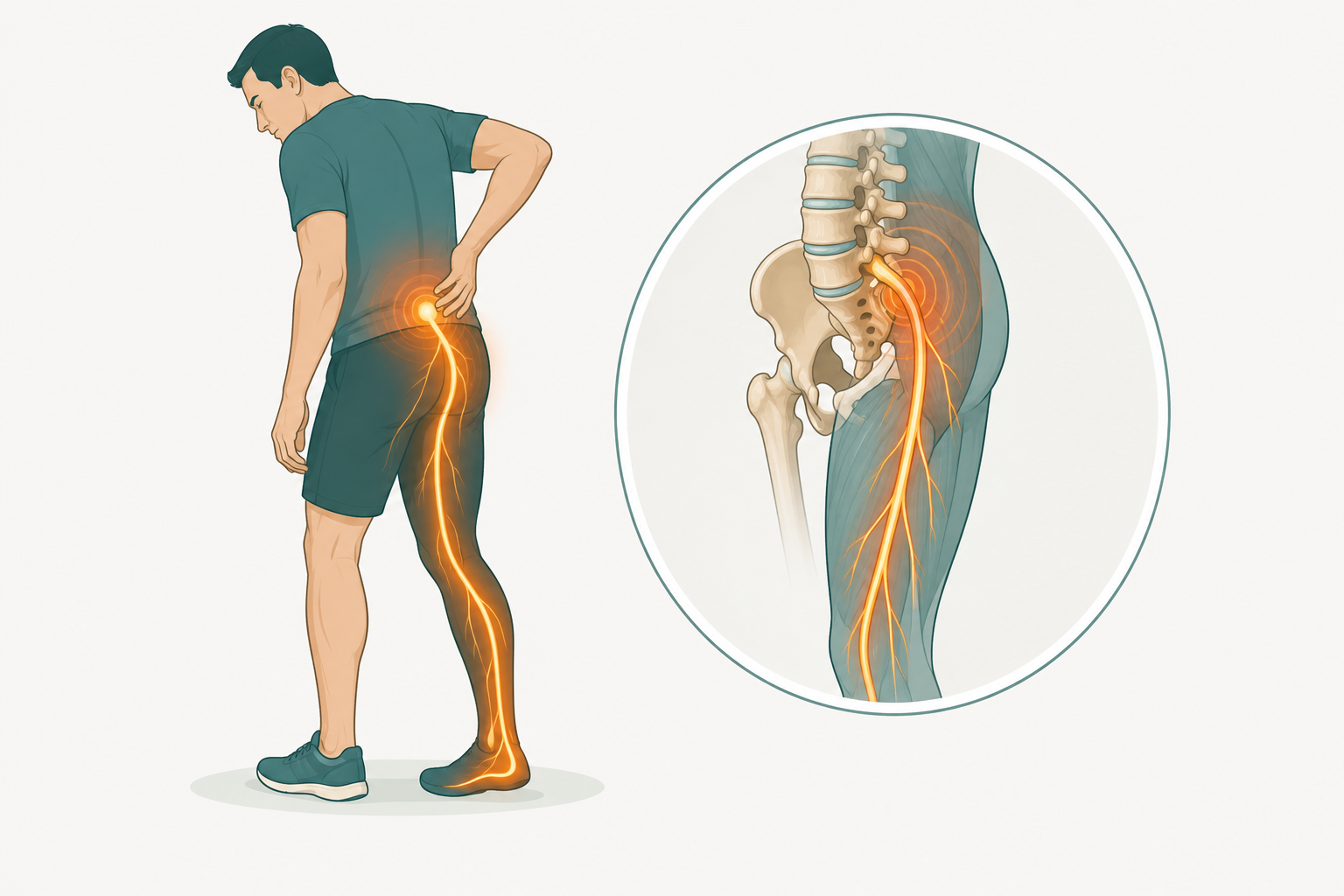
Sciatica pain that shoots from the lower back or buttock down one leg — sometimes to the foot — follows the path of the sciatic nerve. It travels because the nerve is irritated or compressed near the spine or in the buttock, so the pain refers along the nerve instead of staying put. That one-sided, shooting, electric quality is what tells sciatica apart from an ordinary sore back.
Most people describe it the same way: "it's like a cable being yanked from my back down to my foot." That's not poetry — it's almost literally what's happening. And once you understand why it travels, the right moves start to make sense.
Why the pain shoots down your leg
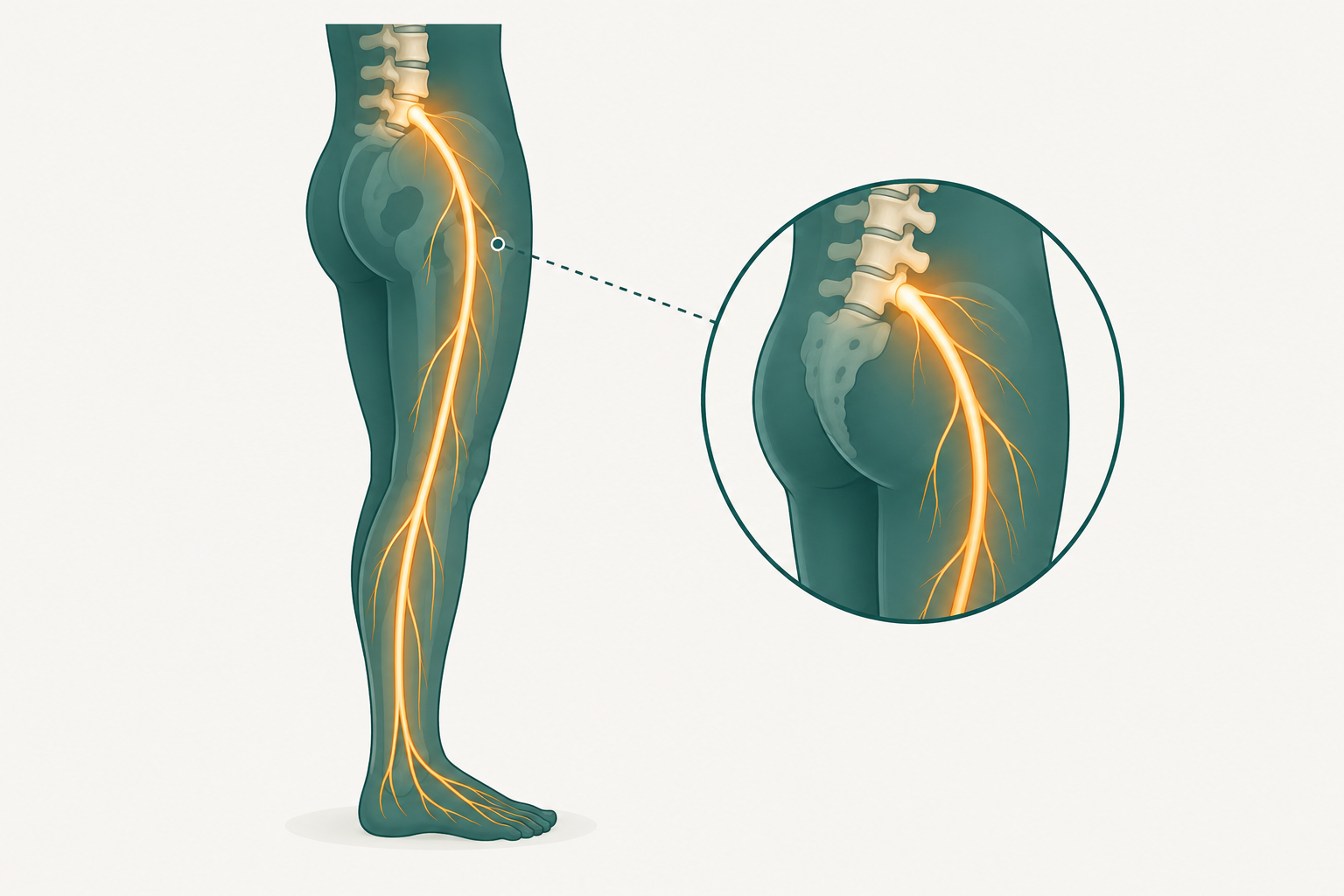
The sciatic nerve is the longest, widest nerve in your body — from your lower spine, through each buttock, down the back of each leg to the foot.
Because it runs so far, irritation at its root (near the spine) or along its path (in the buttock) hurls pain signals outward — so you feel them screaming down the leg, even though the real trouble may be way up top. Doctors call it referred pain. You call it that cable down your leg. Either way, it's the signature of sciatica.
The classic pattern:
- Starts in the lower back or buttock
- Fires down one leg (rarely both)
- Sometimes reaches the calf, foot, or toes
- Electric, burning, shooting quality
- Worse sitting, driving, or standing up
- Often drags tingling or numbness along with it
What pulls the trigger
| Trigger | What's going on |
|---|---|
| Herniated / bulging disc | Disc material presses on the nerve root |
| Spinal stenosis | A narrowed canal crowds the nerve |
| Piriformis tension | A deep buttock muscle clamps down on it |
| Prolonged sitting | Steady pressure keeps it inflamed |
| Inflammation | Turns an already-angry nerve up to eleven |
That last one matters more than most people realize: inflammation cranks up the volume on an irritated nerve. Full breakdown here: what causes sciatic nerve pain.
Why "it's just your disc" doesn't add up
If they blamed a disc on a scan and stopped there, here's the missing piece: scans of pain-free people find disc bulges and degeneration all over the place, climbing with age — from about 37% of 20-year-olds to 96% of 80-year-olds.
So the disc alone doesn't decide whether — or how badly — you hurt. What usually flips a quiet disc into a screaming leg is an irritated, inflamed nerve. And that opens up relief that has nothing to do with what a photo of your spine shows.
When to see a doctor
Get care fast if you have:
- Loss of bladder or bowel control (emergency)
- Progressive weakness or numbness in the leg
- Numbness in the groin/inner-thigh (saddle) area
- Sciatica after a fall or injury
- Severe pain that won't ease over a few weeks
Frequently asked questions
Why does sciatica pain go all the way down my leg?
The sciatic nerve runs from the lower spine down each leg to the foot. Irritate it near its root and the pain refers along the nerve — so it fires down the buttock and leg, sometimes to the foot, even though the source may be higher up.
Why is sciatica usually only in one leg?
Sciatica usually hits one side, because the irritation or compression — a disc, stenosis, or a tight muscle — sits on one side of the spine or in one buttock. Both legs at once is less common and worth flagging to a doctor.
Does sciatica down the leg mean nerve damage?
Radiating pain means the nerve is irritated — not necessarily permanently damaged. Many cases improve. Persistent numbness, weakness, or red-flag symptoms should be checked to rule out serious compression.
Can sciatica reach the foot and toes?
Yes. The sciatic nerve reaches all the way to the foot, so pain, tingling, or numbness can travel the whole distance, depending on which fibers are affected.
What helps sciatica leg pain?
Staying mobile, targeted stretching, calming inflammation, supporting nerve health, and physical therapy commonly help. Severe or stubborn pain — or any red flags — need a medical eval.
Sources
- Mayo Clinic — Sciatica (radiating pain, one-sided pattern, red flags)
- Brinjikji et al., AJNR 2015;36(4):811 — asymptomatic disc degeneration 37%→96%
- NINDS — sciatic nerve anatomy / low back pain
- PubMed — referred pain mechanisms in sciatica
This article is for general educational purposes only and is not medical advice. It has not been evaluated by the FDA and is not intended to diagnose, treat, cure, or prevent any disease. Always consult a qualified healthcare provider about your symptoms.