What Causes Sciatic Nerve Pain?
They pointed at your MRI, said "bulging disc," and sent you home. Case closed. Except here's what they didn't mention: most pain-free adults over 50 are walking around with the exact same "bulging disc" — and feeling nothing. So if a disc alone doesn't cause pain, what's actually lighting up your leg? That's the question this page answers.
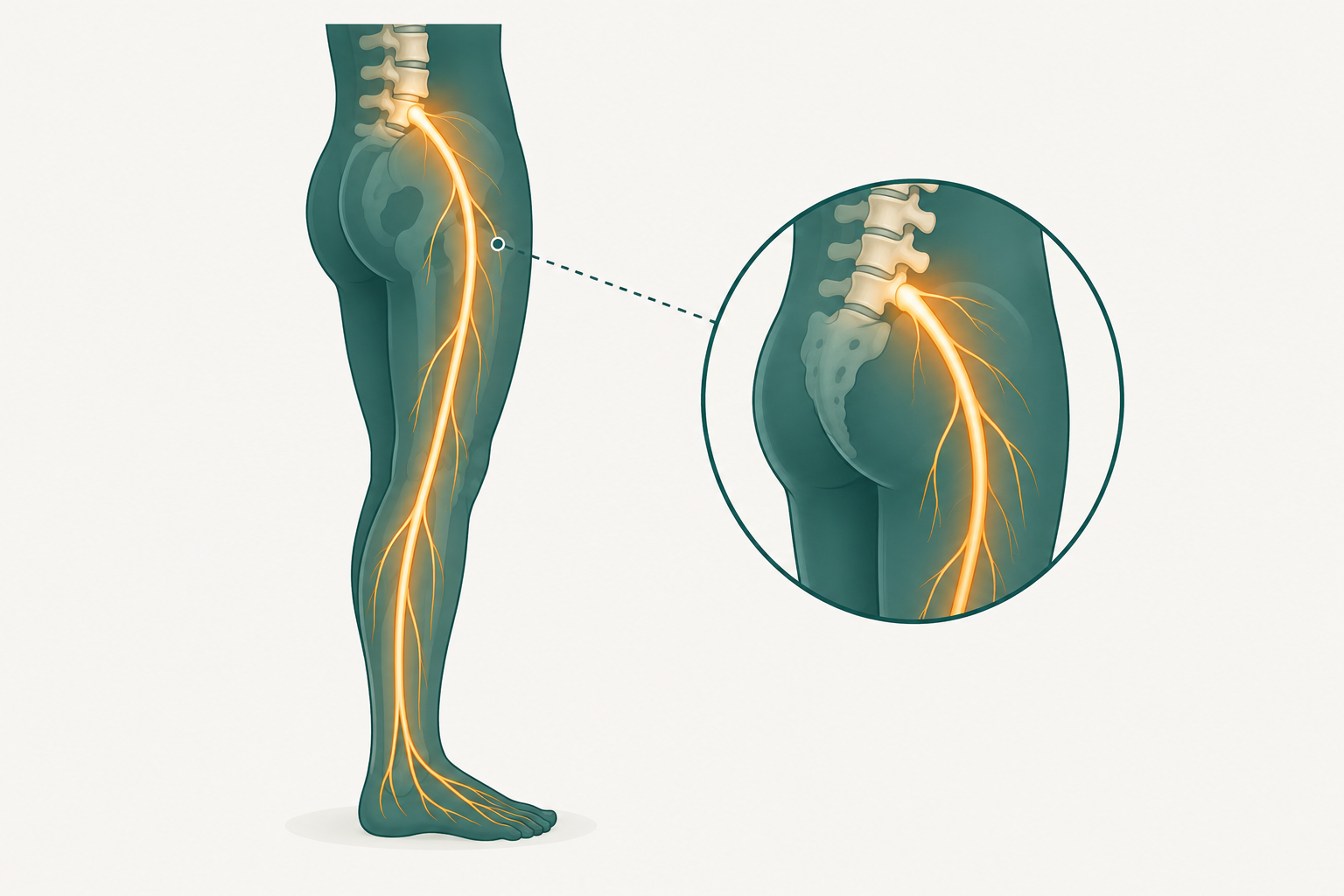
Sciatic nerve pain — felt in the lower back, buttock, and down one leg — is usually caused by irritation or compression of the sciatic nerve, most often from a herniated disc, spinal stenosis, or a tight piriformis muscle. But here's what stuns most people: the majority of adults over 50 have disc bulges with no pain at all. Which means inflammation and nerve health, not just the disc itself, decide whether it actually hurts.
If your whole explanation for months of agony is "a disc on a scan," you've been handed half a story. Because that same finding shows up in people who feel perfectly fine. Stick with me — this reframe is the most useful thing you'll read about sciatica, and it opens doors that have nothing to do with a scalpel.
Where the nerve runs — and why the pain travels
The sciatic nerve is the longest and thickest nerve in your body. It's born in your lower spine, threads through each buttock, and runs all the way down the back of each leg to the foot.
Because it's so long, irritation anywhere along it can fire pain, tingling, or numbness away from the source. That's the trick of sciatica: it feels like it's "in your leg" even when the real trouble sits up near the spine or deep in the buttock. That shooting, one-sided, electric quality — sometimes all the way to the toes — is what separates sciatica from a plain sore back.
The classic signs:
- Pain from the lower back or buttock firing down one leg
- Electric-shock or burning zaps along the leg
- Pins-and-needles or numbness in leg, foot, or toes
- Worse when you sit, drive, or climb out of a chair
- Weakness in the affected leg
The real causes of sciatica
| Cause | What it is | How it fires up sciatica |
|---|---|---|
| Herniated / bulging disc | A spinal disc pushing outward | Can touch and irritate the nerve root |
| Spinal stenosis | Narrowing of the spinal canal | Crowds the space around the nerve |
| Piriformis syndrome | A tight deep buttock muscle | Clamps the nerve running beneath it |
| Degenerative changes | Age-related spine wear | Narrows the nerve's pathways |
| Inflammation | Ongoing irritation around the nerve | Turns the volume of pain way up |
Notice something: only some of those are "structural." That last one — inflammation — is the reason two people with identical scans can live in completely different worlds of pain.
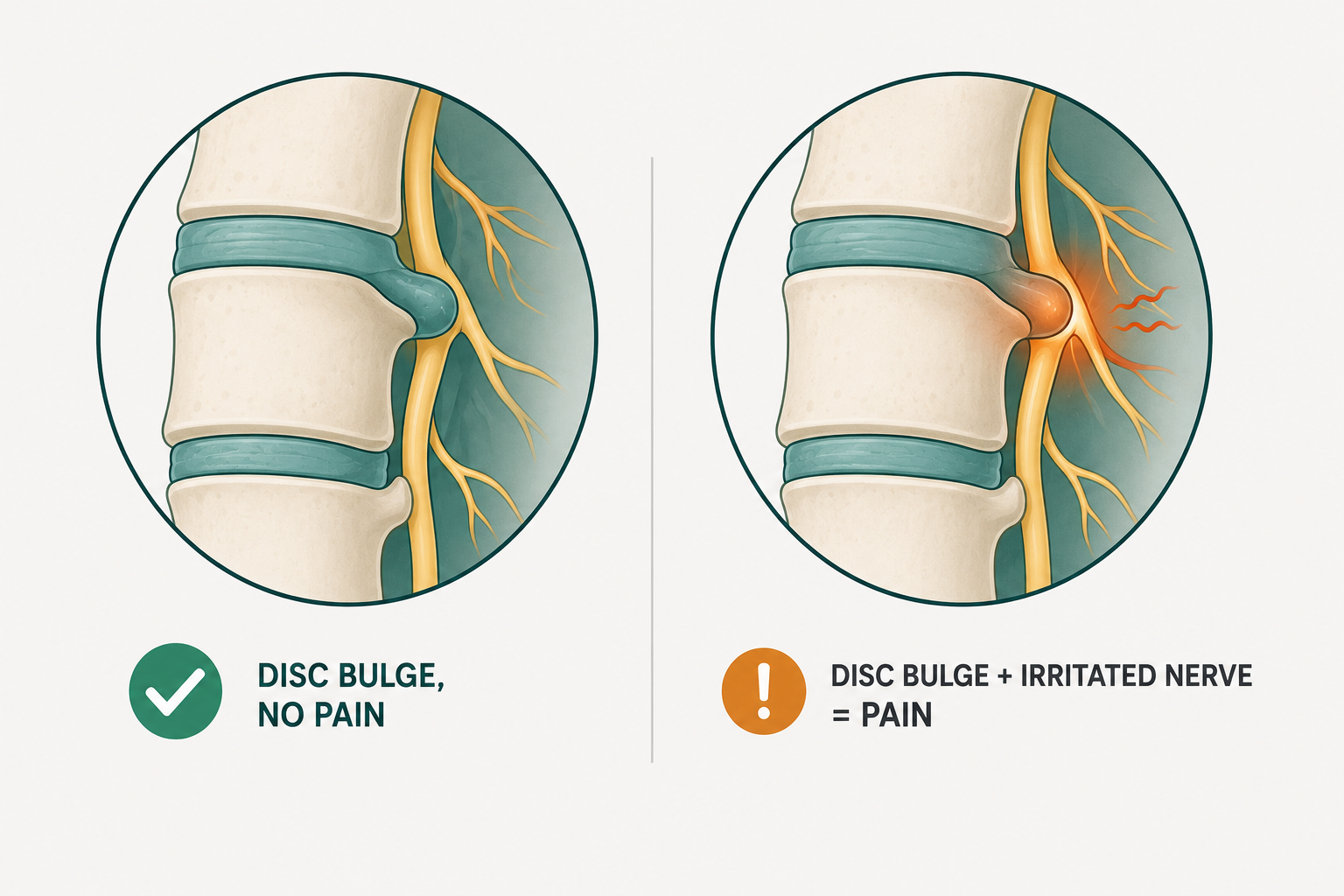
Why a disc bulge doesn't have to hurt (the fact that changes everything)
This is the single most freeing thing to understand about sciatica.
When researchers scanned people with zero back pain, they found disc bulges and degeneration everywhere — and rising steadily with age. Translation: a huge share of totally pain-free adults carry the exact "abnormality" that gets blamed for your suffering.
So no — the disc isn't nothing. But it's rarely the whole story. What usually flips a silent disc into screaming, down-the-leg pain is an irritated, inflamed nerve. And that? That's a door. Because it means feeling better isn't held hostage to what your spine looks like on a photograph.
The inflammation-and-nutrient angle nobody mentioned
If inflammation around the nerve decides whether sciatica flares, then anything that dials inflammation up or down suddenly matters a lot.
Which is where nutrition walks in. Your sciatic nerve, like every nerve, needs specific raw materials to work and to keep its protective coating — the B vitamins especially — and several plant compounds are being studied for their anti-inflammatory, antioxidant effect on cranky nerve tissue.
Let me be straight, because you deserve straight: this is a supportive angle, not a replacement for diagnosing a serious structural problem. But for the very common case of an inflamed, irritable nerve, feeding the nerve and calming the inflammation is a reasonable, research-backed direction — one that goes after why the nerve is angry instead of just numbing the leg.
Curious what that nutrient approach actually looks like?
See the nutrient approach being studied for sciatic nerve support →What actually helps sciatica
Most sciatica eases with time — and a combo beats any single move:
- Movement and targeted stretching (lying still usually makes it worse, not better)
- Calming inflammation through nutrition and, when it fits, anti-inflammatory support
- Feeding nerve health with solid B-vitamin status and studied nutrients
- Physical therapy for the mechanics underneath
- A doctor's eval when pain is severe, stubborn, or throwing red flags
There's no overnight miracle, and anyone selling one is lying. But staying mobile while calming the nerve is where the real, lasting relief lives.
When to see a doctor (red flags)
Get care fast if you have:
- Loss of bladder or bowel control (this is an emergency)
- Progressive weakness or numbness in the leg
- Sciatica after a fall or injury
- Numbness in the groin/inner-thigh (saddle) area
- Severe pain that's not budging over a few weeks
These can signal nerve compression that needs urgent care — don't tough it out.
Frequently asked questions
Is sciatica caused by a disc or a nerve?
Sciatica is pain from the sciatic nerve being irritated or compressed. A herniated disc is one common source — but not the only one, and often not the whole story. Spinal stenosis, piriformis tension, and inflammation all feed it. Plenty of people have disc bulges and no pain at all, which is exactly why the disc alone doesn't explain sciatica.
Why does sciatica hurt down the leg and not just the back?
The sciatic nerve runs from the lower spine all the way down each leg. Irritate it near its root and the pain refers along its length — so you feel it firing down the buttock and leg, sometimes to the foot, even when the trouble started higher up.
Can sciatica go away on its own?
Many cases ease over weeks with movement, stretching, and calming inflammation. Some dig in and stay. Anything severe, worsening, or waving a red flag needs a doctor's eyes.
Do vitamins help sciatic nerve pain?
Certain B vitamins support nerve function, and some nutrients are studied for their effect on nerve inflammation and pain. Think of them as support for the nerve, not a cure — and not a substitute for evaluating a structural problem.
What foods make sciatica worse?
Because inflammation amplifies an irritated nerve, some people find highly processed, high-sugar diets crank up the pain while an anti-inflammatory pattern calms it. The evidence is still developing, and individual responses vary.
Sources
- Mayo Clinic — Sciatica (causes, symptoms, red flags)
- NINDS — sciatic nerve / low back pain resources
- Brinjikji W. et al., AJNR 2015;36(4):811 — imaging features of spinal degeneration in asymptomatic populations
- PubMed — lifetime prevalence of sciatica (epidemiology reviews)
- PubMed — B-vitamins and nerve pain (supportive evidence)
This article is for general educational purposes only and is not medical advice. It has not been evaluated by the FDA and is not intended to diagnose, treat, cure, or prevent any disease. Always consult a qualified healthcare provider about your symptoms.