Alpha-Lipoic Acid for Neuropathy: Dosage and What the Research Shows
Most "nerve supplements" are sold on hope and a pretty label. This one is different — and that's why it keeps coming up. Alpha-lipoic acid has been dragged through real human trials, at a real dose, with real results. If you're tired of throwing money at pills that were never tested, start here.

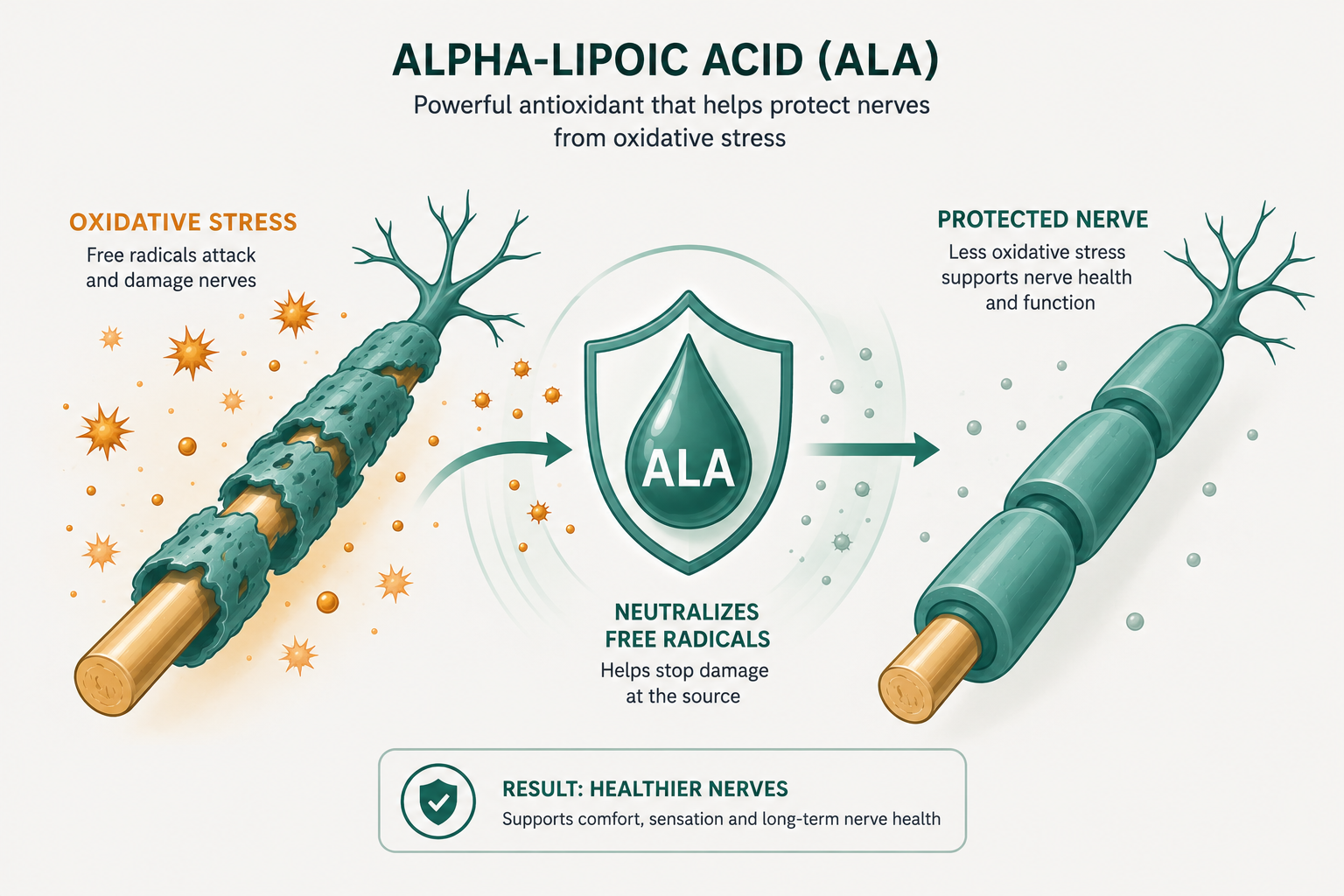
Alpha-lipoic acid (ALA) is one of the most-studied supplements for diabetic neuropathy. Multiple human trials — including the well-known ALADIN and SYDNEY studies — used 600 mg daily and reported less burning, tingling, and numbness over several weeks. ALA is an antioxidant that helps shield nerve tissue from oxidative stress. Its effects build gradually, so consistency over weeks beats any single dose.
Here's why ALA earns its own page while a hundred other "nerve blends" don't: it has actually been tested on people. Not a rat, not a test tube, not a testimonial — real patients, in randomized trials, with symptom scores that dropped. That doesn't make it a miracle. It makes it one of the few honest starting points in a category drowning in hype.
What ALA is actually doing for your nerves
Your body already makes a trace of ALA. As a supplement, it pulls double duty on the exact problems chewing up your nerves:
- It's an antioxidant that reaches the nerve. ALA mops up oxidative stress — the cellular "rust" that grinds nerve fibers down, especially in diabetes. And unlike most antioxidants, it works in both the watery and fatty parts of your cells, so it actually gets where the damage is.
- It supports blood flow and fuel. Research also looks at how ALA helps circulation to the nerves and how nerve cells handle glucose.
So ALA isn't studied to numb the pain. It's studied to fight the conditions that keep your nerves damaged — oxidative stress most of all. Attack the cause, not just the alarm.
600 mg: the number the studies keep landing on
Read enough of this research and one figure gets burned into your memory: 600 mg a day.
- The ALADIN and SYDNEY trials tested ALA in diabetic neuropathy and reported improvements in burning, tingling, prickling, and numbness.
- A meta-analysis pooling four trials (ALADIN I, ALADIN III, SYDNEY, NATHAN II; 1,258 patients) found 600 mg significantly eased neuropathic symptoms (Ziegler et al. 2004).
- Going higher didn't reliably do more — it just piled on side effects. 600 mg is the sweet spot the science keeps circling back to.
This isn't me writing you a prescription — that's your doctor's job — but now you know the yardstick. Hold any product or promise up against it.
How fast? (And where people quit too soon)
Set your expectations here, because this is exactly where people bail. ALA works like compound interest — it builds over weeks, not overnight. In the trials, improvements were measured across several weeks of daily use. Take it for four days, feel nothing, toss the bottle — and you've proven nothing except that you didn't run the experiment.
Oral vs. IV — what the fine print means
You'll bump into mentions of IV (intravenous) ALA. Some of the earliest, strongest results used it, because IV delivers a bigger hit straight to the bloodstream. For real life, oral ALA is what's practical and on the shelf — and oral trials reported symptom benefits too. IV is a clinic decision, not a kitchen one; it's here only so the research makes sense.
Why ALA travels with B vitamins and curcumin
You'll rarely find ALA riding solo in a nerve formula — and there's a reason. Each nutrient hits a different front:
- ALA → oxidative stress
- Curcumin (turmeric) → inflammation
- B vitamins (B12, B1, B9) → rebuilding the nerve's coating
Stack them and you're not betting everything on one card — you're covering the whole table. That's the exact thinking behind the nutrient combinations researchers are studying now.
Want to see ALA combined with turmeric and B vitamins the way it's actually studied?
See the turmeric + ALA + B-vitamin approach →Safety and who should check with a doctor first
ALA is usually well tolerated, but talk to your doctor before you start — especially if you:
- Take diabetes medication (ALA can lower blood sugar — that needs watching)
- Have a thyroid condition (possible interaction with thyroid treatment)
- Have a thiamine (B1) deficiency or drink heavily (fix that alongside)
- Are pregnant or breastfeeding (not well studied at supplement doses)
Side effects are usually mild — a bit of stomach upset, or a dip in blood sugar. "Natural" still isn't "consequence-free."
Frequently asked questions
Does alpha-lipoic acid really help neuropathy?
It has more human clinical research behind it than almost any nerve supplement. Trials in diabetic neuropathy — including ALADIN and SYDNEY — reported less burning, tingling, and numbness at 600 mg a day. It's studied as nerve support, not a guaranteed cure, and the results build over weeks.
What's the best dose of alpha-lipoic acid for nerve pain?
Research keeps landing on 600 mg per day. Pushing higher didn't reliably add benefit and raised side effects. Confirm the right dose with your doctor, especially if you're on diabetes medication.
How long does alpha-lipoic acid take to work?
Weeks of consistent daily use — not a few days. If you test it for a long weekend and quit, you never gave it the chance the studies did.
Can I take alpha-lipoic acid with gabapentin?
They work differently and are sometimes used together, but clear any combo with your doctor or pharmacist first — and never stop a prescribed medication on your own.
Is alpha-lipoic acid safe long-term?
It's generally well tolerated in studies. The main watch-outs are blood sugar (if you're on diabetes meds) and thyroid treatment. Talk long-term use through with your provider.
Sources
- Ziegler D. et al., meta-analysis 2004 (PubMed 14984445) — 4 trials, 1,258 patients
- SYDNEY 2 trial — oral 600 mg/day optimum risk-to-benefit; ALADIN III (PubMed 10480774)
- PubMed — recent meta-analyses supporting oral 600 mg symptom benefit
- NCCIH / Mayo Clinic — alpha-lipoic acid safety and interactions
This article is for general educational purposes only and is not medical advice. It has not been evaluated by the FDA and is not intended to diagnose, treat, cure, or prevent any disease. Always consult a qualified healthcare provider before starting any new supplement, especially if you take medication or have a health condition.